

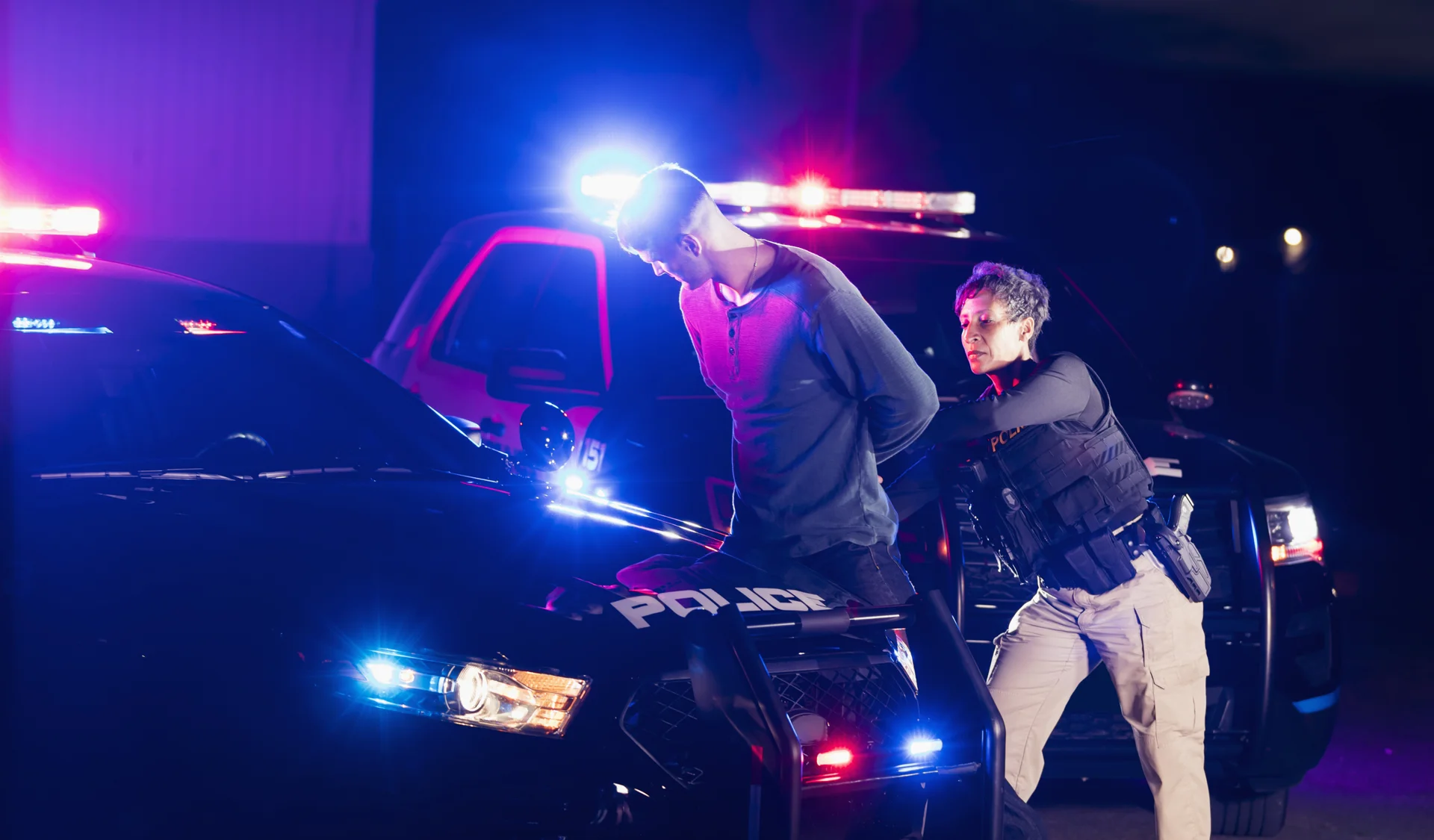
If you've ever wondered whether a police officer can legally pat you down or search your vehicle without a warrant, the short answer is: sometimes, yes, but only under specific, limited circumstances. The law doesn't give police unlimited authority to search whoever they want, whenever they want. Instead, there are clear legal boundaries that protect your rights, and understanding those boundaries could make a real difference if you ever find yourself in that situation.
When you hear the phrase "pat down" or "stop and frisk," it's not hard to imagine what this looks like. We've all seen it portrayed in numerous movies and TV shows. An officer approaches a potential suspect, spins them around, maybe has them put their hands on a vehicle or wall, and frisks them for weapons. However, what is rarely portrayed in these scenes is the legality of such actions. The landmark Supreme Court case of Terry v. Ohio and its progeny shines light on the truth that everyone should know.
Terry v. Ohio
Much of the law surrounding stop-and-frisk by police officers stems from the case Terry v. Ohio, the facts of which are pretty straightforward.
A Cleveland police officer named Martin McFadden observed John Terry and two other men repeatedly walking past a store, peering inside, and conferring with each other. Through his training and experience as a law enforcement officer, Officer McFadden believed they were planning a robbery and that they may be armed.
Officer McFadden approached the group, questioned them briefly, and then conducted a pat-down of Terry's outer clothing. During this pat down, he felt a gun and retrieved it. In a motion to suppress, Terry argued that the pat-down was an unlawful search in violation of the Fourth Amendment, not supported by probable cause.
The Supreme Court disagreed. The Court held that “where a police officer observes unusual conduct which leads him reasonably to conclude in light of his experience that criminal activity may be afoot and that the persons with whom he is dealing may be armed and presently dangerous, where in the course of investigating this behavior he identifies himself as a policeman and makes reasonable inquiries, and where nothing in the initial stages of the encounter serves to dispel his reasonable fear for his own or others' safety, he is entitled for the protection of himself and others in the area to conduct a carefully limited search of the outer clothing of such persons in an attempt to discover weapons which might be used to assault him.” Terry v. Ohio, 392 U.S. 1, 30, 88 S. Ct. 1868, 1884–85, 20 L. Ed. 2d 889 (1968)
What this means in practice is that an officer may pat somebody down if they have "reasonable suspicion" that criminal activity is afoot and that the person is presently armed and dangerous. Rather than requiring probable cause, the Court established a lower standard of reasonable suspicion, one that must be supported by specific, articulable facts and not merely a hunch. And this principle doesn't stop at pat-downs of individuals. Courts have extended it to personal vehicles as well.
Michigan v. Long
The Supreme Court extended this principle in Michigan v. Long. In that case, officers stopped a driver who had been observed driving erratically, speeding, and who had run his car off the road into a ditch. While speaking with the driver, officers noticed a large hunting knife on the floorboard of the car. Concerned for their safety, they searched the passenger compartment of the vehicle and found drugs.
The Court applied the logic of Terry, holding that, “A limited, warrantless search of the passenger compartment of an automobile may be conducted if the officer possesses a reasonable belief based on specific and articulable facts which, taken together with the rational inferences from those facts, reasonably warrant the officer in believing the suspect is dangerous and the suspect may gain immediate control of weapons.” Michigan v. Long, 463 U.S. 1032, 1049, 103 S. Ct. 3469, 3481, 77 L. Ed. 2d 1201 (1983).
It's important to understand that this is not an exhaustive search; it is limited in scope. The sole purpose of this rule is to ensure officer safety, and it only permits the search of areas where weapons could be readily accessed. For example, a suitcase in the trunk of a car would not qualify, as it is not an area where a weapon could be immediately accessible to a suspect.
What These Legal Rules Mean for You
Together, these cases outline the circumstances in which officers can legally pat you down or perform a limited search of your vehicle for weapons. The common thread throughout is the requirement of "reasonable suspicion" supported by specific, articulable facts that suggest either criminal activity or the presence of weapons and danger.
Although these rules are grounded in officer safety, that does not mean they are without limits. Evidence seized as part of these searches is frequently challenged through motions to suppress, which test whether the officers' suspicion truly met the legal standard. If it didn't, that evidence may be kept out of court entirely, and that can change everything about a case.
Think a pat-down was Unlawful? Call Our Firm
At Cofer & Connelly, PLLC, we know how high the stakes are when you're facing criminal charges. Our team brings more than 200 years of combined legal experience to the table, including attorneys who have served as prosecutors and judges, so we understand how the other side thinks and what we can do to challenge them.
To date, we've taken more than 300 cases to jury trial and have handled thousands of cases across Texas, maintaining a 95% success rate in criminal defense. When evidence in your case was obtained through a pat down or vehicle search, we know exactly what questions to ask and where to look for weaknesses in the prosecution's position.
If you're facing criminal charges based on evidence obtained during a frisk of your person or your vehicle, don't navigate the complexities of search and seizure law alone. Call (512) 991-0576 today for a consultation with an experienced Austin criminal defense attorney.