


Recently, members of Cofer & Connelly, PLLC secured favorable outcomes in two separate felony trials, each involving clients who were facing significant prison time. Although these two trials took place within the same week, they were separated by hundreds of miles and by two completely different legal strategies.
In Bell County, Attorney Jeremy Sylestine and Attorney Brian Gullickson obtained a full acquittal by focusing the jury on a specific provision of Texas's self-defense law involving the defensive display of a weapon. In Lubbock County, Attorney Geoffrey Puryear and Attorney Kevin Garcia made the strategic decision to request a lesser-included offense, giving the jury a path away from a felony conviction. Together, these two results show that there's no single formula for defending a case at trial. Two different strategies, two different statutes, and two very different choices placed in front of a jury, yet both led to the outcome our clients needed.
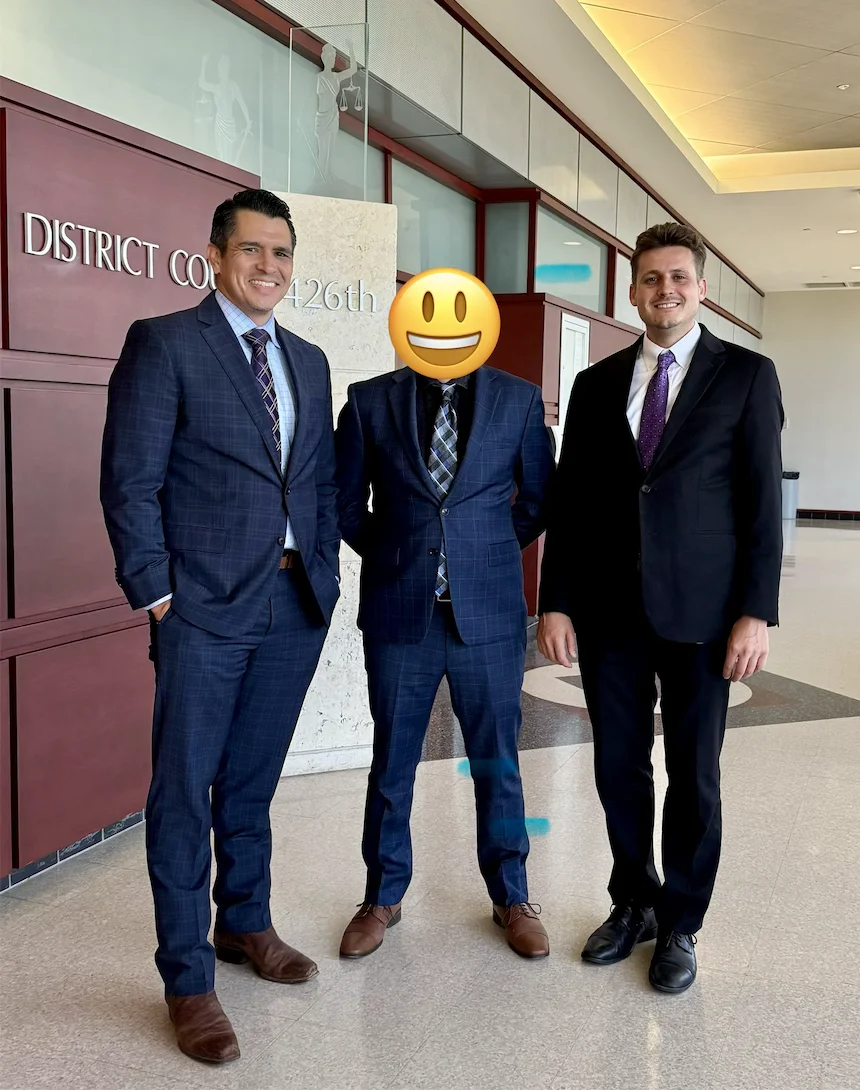

Partner Jeremy Sylestine and Associate Brian Gullickson with client.
Aggravated Assault with a Deadly Weapon: Self-Defense & Defensive Display
The first case, handled by Attorneys Sylestine and Gullickson, involved a private investigator charged with aggravated assault with a deadly weapon. Our client had been hired to investigate potential violations of a temporary restraining order involving intellectual property. While conducting that investigation, he entered a property after business hours to determine whether the intellectual property in question was being used to build products.
An employee of the property approached our client in a pickup truck and questioned him about why he was there. At one point, the employee asked our client to leave; our client disputed the employee's authority to order him off the property and suggested the employee call 911 if there was an issue.
As our client walked away, his cell phone recording captured the employee saying he wanted to “make this personal” before exiting his truck and quickly approaching our client from behind. It was at this point that our client turned, drew his firearm, and initially held it at a low-ready position. Later in the encounter, the employee swung at our client, prompting him to raise the firearm and order the employee to back away.
These facts allowed our attorneys to raise a defense under Texas Penal Code Section 9.04. Under this provision, a threat to cause death or serious bodily injury through the production of a weapon or otherwise does not constitute the use of deadly force, so long as the actor’s purpose is limited to creating an apprehension that deadly force will be used if necessary. Jeremy and Brian successfully obtained a Section 9.04 instruction in the court’s charge to the jury.
The State presented 11 witnesses and approximately 41 exhibits, including 911 audio, body camera footage, cell phone video, and the firearm itself. The State argued that our client's refusal to leave the property undermined his claim of self-defense. Jeremy and Brian, in contrast, urged the jury not to conflate the trespass issue with the ultimate question of self-defense. The jury still had to determine whether our client's conduct amounted to reasonable and justified force under the circumstances. After approximately three and a half hours of deliberation, the jury returned a not guilty verdict.
Strangulation & Another Lesser-Included Offense
The second case, handled by Attorneys Geoffrey Puryear and Kevin Garcia, involved a felony charge of Assault Family Violence by Strangulation. The State alleged that our client had violently assaulted his wife, punching her, repeatedly striking her, and strangling her. But as evidence was turned over and the case was evaluated, serious questions emerged about whether the physical evidence and the investigation behind it supported that version of events.
Officers arrived on scene within an hour of the 911 call. One officer spoke with our client while another spoke with the complaining witness. Roughly nine minutes passed before officers decided to place our client under arrest, which was a decision made without the two officers even comparing what each had learned from their respective conversations. Of particular importance was bruising on the complaining witness's face. While photos of that bruising were admitted at trial, the evidence established that it predated the alleged assault and was actually the result of a cosmetic procedure.
Geoffrey and Kevin were able to highlight several inconsistencies in the complaining witness’s statements, and contrasted this investigation with a prior domestic violence call involving the same two people. During that earlier incident, an officer had interviewed both parties, evaluated the available physical evidence, and made no arrest, despite the complaining witness having broken a door off its hinges. This “tale of two investigations” became a central theme of closing arguments.
Even so, our client faced real risk at trial. The couple's adolescent child testified to seeing his father with his hands near or around his mother's neck. In response, Geoffrey and Kevin made the strategic decision to request that the jury also be given the option of the lesser-included offense of Misdemeanor Assault Family Violence. This was a fundamentally different approach than the affirmative defense raised in the aggravated assault case we discussed first. Rather than forcing the jury to choose only between a felony conviction and a full acquittal, this instruction gave jurors a middle path that allowed them to believe an assault occurred while also concluding that the State had failed to prove the element of strangulation beyond a reasonable doubt.
After approximately five hours of deliberation, the jury found our client not guilty of the felony he was facing and instead convicted him of the lesser-included misdemeanor offense. That distinction changed everything: instead of a potential sentencing range of two to ten years in prison, the client received a sentence of probation.
Two Cases, Two Strategies, Two Wins
These two trials show just how differently a favorable outcome can be reached in a felony case. In one, the jury was focused entirely on a justification defense under the law. In the other, the strategic decision to request a lesser-included offense ensured the jury wasn't stuck with an all-or-nothing choice. Both approaches required an intricate understanding of the applicable law, the specific facts at hand, and a clear read on what a jury needed to hear to reach a favorable result.
Results Like These Don't Happen by Accident
At Cofer & Connelly, PLLC, we understand that no two cases are the same. That's why we don't approach every trial with a one-size-fits-all playbook. Instead, we prepare a strategy around the specific facts of your case, whether that means raising an affirmative defense, challenging the strength of the State's investigation, or identifying a path to a lesser charge when it's in your best interest.
Our team brings more than 200 years of combined legal experience to every case, and we've taken more than 300 cases to jury trial. With attorneys who have served as both prosecutors and judges, we understand these cases from every angle, and we've maintained a 95% success rate in criminal defense because we put in the work to find the right approach for every client we represent.
If you're facing serious felony charges in Texas, the strategy we choose will depend entirely on the facts of your case, but the commitment to fighting for the best possible outcome never changes. Contact us online or call (512) 991-0576 today.